
Every person’s right to decide where, under what conditions and for how long they live must be respected. Regardless of whether the person is institutionalized or not, whether they have a disability or not. It is a right rooted in the guarantee of human dignity. Securing a decent form of housing is the premise for further personal development.
It is the first and most important area of life, in which a person’s basic needs must be met, because once housing requirements are fulfilled, the person can take a step toward a new level of self-affirmation. This includes meeting private needs related to the home, aspects of personal hygiene and self-management. The UN Declaration on the Rights of Persons with Disabilities, also signed by Romania, clearly refers to the right to housing — more than that, the right of a person with a disability to decide how and where they wish to live.
In this context, the Alsterdorf Association makes every effort to offer forms of assisted living to people with disabilities and, moreover, to continuously improve the living conditions of people living in apartments and houses, and to normalize the way of life of people who cannot manage their own household alone.
Thus, in addition to the 43 places in protected housing, the Alsterdorf Association offers home support and outpatient assistance services to people with disabilities who wish to live independently. The purpose of this assistance offer is to facilitate the community inclusion of institutionalized people with disabilities and to support people with disabilities who already live independently or with family, so they don’t end up at risk of institutionalization. Currently 7 people and two families benefit from this service.
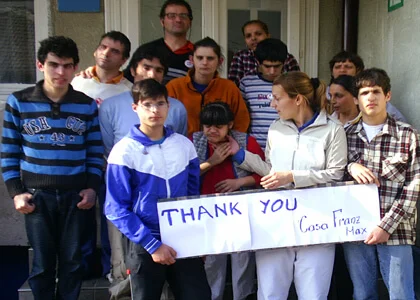
The protected homes — Franz Max House, Săcueni House and the five apartments — located in Oradea and Săcueni, were established in 2005 and, respectively, 2009 (Săcueni House) in collaboration with the Bihor General Directorate for Social Assistance and Child Protection. They were taken over from D.G.A.S.P.C. Bihor in December 2011 into our own administration. Here, the 43 adults with intellectual and psychiatric disabilities live, guided by assistants, psychologists and educators with the aim of preparing them for an independent life. In the Casa Max protected home, two of the 10 residents with intellectual and psychiatric disabilities are visually impaired.
Twenty-six people with disabilities, who were previously assisted in protected homes, now live independently and continue to benefit from outpatient assistance services through the Home Socio-Educational Assistance Service.
Based on a well-structured plan to expand services into larger centers as well, where people with disabilities live, the Alsterdorf Association’s leadership decided to take a more active part in the process of deinstitutionalizing large social care institutions, taking over from D.G.A.S.P.C. Bihor in July 2014 the Cadea Integration Through Occupational Therapy Center — an institution where 50 adults with intellectual and psychiatric disabilities live. Here, the needs for hygiene improvements and redesign of spaces, for structuring daily and weekly activities, for staff specialization and for introducing a healthy and effective concept of occupational activities are so great and so necessary that our organization launched a broad fundraising effort (donations and sponsorships) to set this center’s 50 beneficiaries on the path to a normalized life.
In 2023, D.G.A.S.P.C. Bihor took the Cadea Integration Through Occupational Therapy Center back under its own administration.
So, we can say that we offer support and assistance to 69 people with intellectual, psychiatric and associated disabilities.