
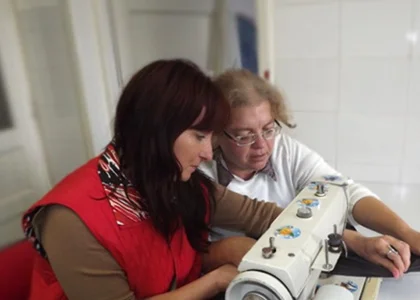
A sense of usefulness and self-esteem are cultivated in people with intellectual and psychiatric disabilities through their involvement in meaningful activities. Knowing the purpose of the activities or actions these people are involved in ensures greater engagement, responsibility, and the development of willpower and self-determination.
This area of life covers those aspects of life related to personal development, self-affirmation and building a sense of usefulness. For this area of life we offer social skills training — communication, cooperation and conflict resolution — for people with intellectual disabilities or for those who cannot write or read: the C.C.C. Seminar.
The C.C.C. Seminar is structured into three modules: Communication, Cooperation and Conflict Resolution, during which participants can learn behaviors appropriate to different workplace situations. Here, through role-play, participants learn and practice relationships between coworkers, between employee and supervisor, ways to avoid or resolve workplace conflicts, how to respond to positive criticism, how to express criticism, etc. These trainings are also open to other people with disabilities beyond those living in our homes.
In this context, we organize and run seminars and meetings on accessing, keeping, and the importance of a job, as well as ways of responding to workplace difficulties or conflicts. We support people with disabilities in finding a job, prepare them for that job, and — what we consider of utmost importance — offer workplace assistance: direct support at the workplace for the person with an intellectual or psychiatric disability, until they manage to settle in.
For people with disabilities who, for various reasons, cannot access a job on the open market, we offer the ALSTERART occupational workshops. The purpose of these workshops is to prepare people with disabilities to access a job. In the four workshops, participants learn to follow a work schedule, alternate work periods with scheduled breaks, complete a task, work as a team, and behave appropriately in a workplace. These workshops produce handcrafted items, which are then sold. The income obtained covers the costs of purchasing raw materials, and those who take part in the activities are rewarded. Here we produce: candles, soaps, paintings, baubles, bracelets, ornamental bottles, painted plates, etc. Four more workshops will soon be operating at the Cadea Center.
We look with particular admiration and interest on people who wish to provide services or carry out various volunteer activities for the benefit of people with disabilities in our homes. We encourage this civic spirit and even financially support projects organized for this purpose. We call this — internal volunteering. At the moment we have around ten people involved in various forms of volunteer activity.
A special aspect is external volunteering: people with intellectual or psychiatric disabilities who live in the Alsterdorf Association’s homes are themselves involved in various volunteer activities in the community: a team of five people with disabilities from Frankfurt House provides cleaning services once a week at the city zoo; another person volunteers at a retirement home in Oradea. During the Winter Holidays or Easter, our beneficiaries organize themselves into groups and make small gifts or prepare food for people in need in the community.
The day center for people with psychiatric or intellectual disabilities is a support service aimed primarily at families that include a person with a psychiatric or intellectual disability. Our goal is to support the family and keep the person with a disability within the community; to this end, we carry out life-preparation activities, day-structuring activities, occupational activities and workplace-integration activities. Over 40 clients take part in the center’s activities.